There aren’t many bathroom upgrades that appeal equally to a 40-year-old who reads design blogs and a 65-year-old who’s thinking about staying in their home for the next 20 years. A curbless shower is one of them.
Open any shelter magazine or scroll through a high-end bathroom renovation on Houzz and you’ll see the same thing: seamless tile running from the bathroom floor straight into the shower, no step, no curb, no visual interruption. It’s the look that’s taken over modern bathroom design. What most people don’t realize is that the same feature making those bathrooms look like a boutique hotel is also one of the smartest long-term investments a homeowner can make for safety and accessibility.
That dual appeal is what makes a zero-entry shower worth understanding before your next bathroom remodel. Let’s uncover what’s behind the trend, what the construction actually involves, what to budget in the DFW market, and the design decisions that separate a great curbless shower from a mediocre one.
Why Curbless Showers Are Replacing Traditional Designs
The curb on a standard shower was never really a design decision. It was an engineering default, a simple way to keep water inside the shower without doing more complicated floor work. For decades, nobody questioned it much. That’s changed.
Safety that Doesn’t Look Like Safety
The step over a shower curb is one of the most common fall hazards in the home. For older adults, it’s a real concern. The traditional answer involved grab bars, shower chairs, and transfer benches, all of which work but can make a bathroom feel clinical, which many homeowners find discouraging.
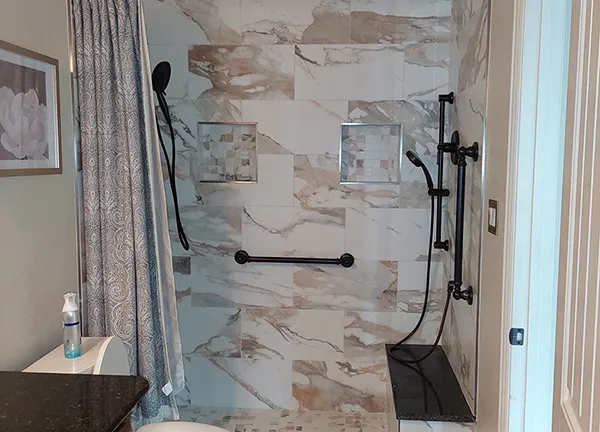
A curbless shower removes the step entirely. It accommodates a shower chair without any modification. It provides wheelchair access if needed. And it does all of that without a single feature that announces itself as an accessibility accommodation. It just looks like a well-designed bathroom, because it is one.
The Aesthetic Case
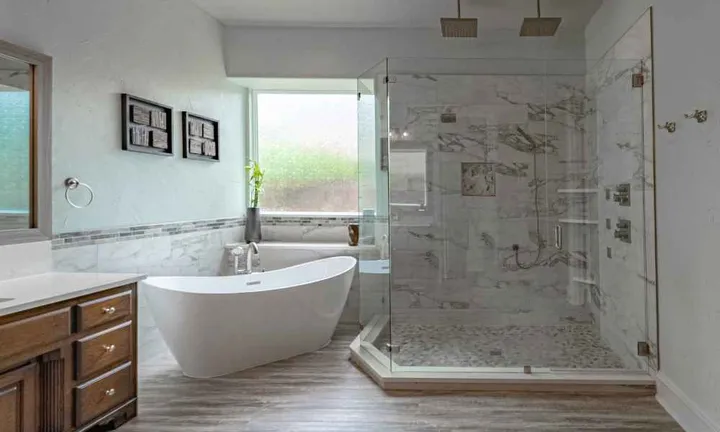
Frameless glass. Large-format tile. A linear drain tucked against the wall. No curb breaking the floor plane. That’s the combination showing up in every high-end bathroom renovation right now, and the curbless design is what makes it possible. When there’s no curb, the floor tile can run continuously from the shower into the rest of the bathroom. The space reads as larger and more cohesive. It’s a cleaner look in every sense.
It’s Easier to Clean
This one surprises people. The grout line along the top of a shower curb is one of the more stubborn spots in any bathroom to keep clean. Soap residue and mineral deposits settle there. Mildew follows. Remove the curb, and you remove that problem.
Homeowners who’ve switched consistently mention cleaning as a benefit they didn’t anticipate but genuinely appreciate.
It Works for Everyone
A curbless shower doesn’t require any planning around who can use it. Kids, elderly guests, someone recovering from surgery, a family member who uses a mobility device: the shower works the same way for all of them. That kind of universal usability is harder to put a dollar value on, but it matters in a home where multiple generations come and go.
The Engineering: Why It’s Harder Than It Looks
A finished curbless shower looks effortless. The work behind it is more involved than a standard shower build, and it’s worth understanding why before you hire anyone to do it.
Getting the Slope Right
A curbed shower relies on the curb to contain water. A curbless shower relies entirely on the floor slope. The floor has to pitch toward the drain at a consistent grade, typically a quarter inch of drop per linear foot, across the entire shower area. If the slope is off, water drifts toward the bathroom floor instead of the drain. If it’s inconsistent, water pools. This isn’t a step you can approximate and fix with caulk. It has to be right before the tile goes down.
Linear Drains vs. Point Drains
A point drain in the center of the shower requires the floor to slope toward it from all four sides. A linear drain along one wall lets the floor slope in a single direction, which is simpler to execute and allows for larger tile formats without as many cuts.
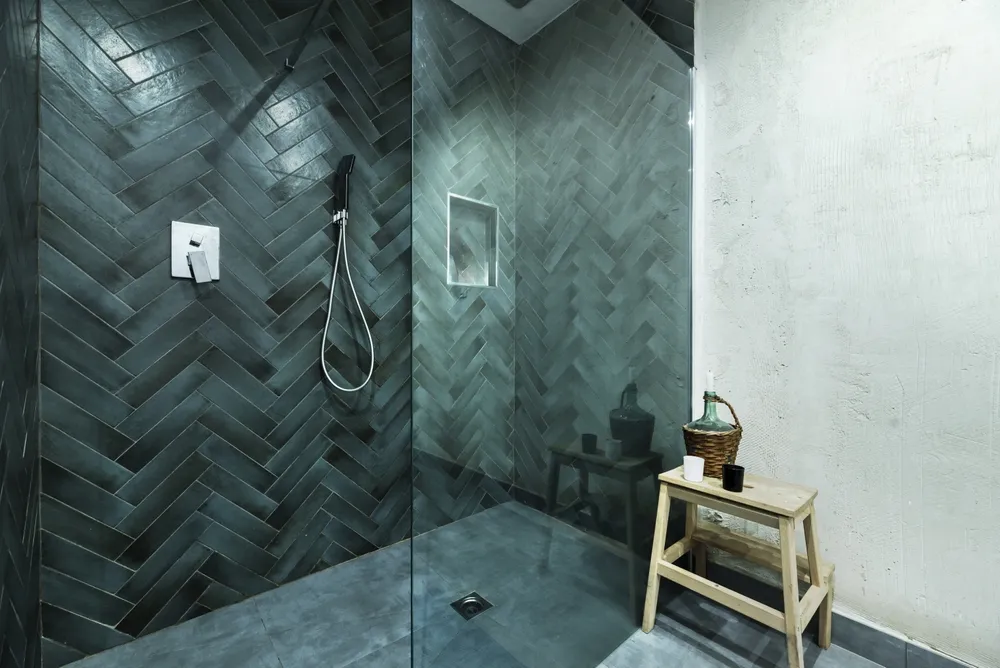
Linear drains also produce a cleaner visual result, which is why they’ve become the default choice in design-forward installations. If the look matters to you, it’s worth the conversation with your contractor about which drain type fits your layout.
Waterproofing is Everything
This is the part that separates a curbless shower that performs well for 15 years from one that starts causing problems after 18 months. Without a curb acting as a secondary barrier, the waterproofing membrane does all the work. It has to cover the entire shower floor, extend up the walls to the right height, and be fully sealed at every seam, corner, and penetration. There’s no margin for shortcuts.
Waterproofing failures don’t announce themselves right away. They show up later as soft spots underfoot, tile coming loose from beneath, or staining on the ceiling of a room below. By the time those signs appear, the remediation cost is high. This is one area where the quality of the contractor matters more than almost anything else.
Older Homes Need Extra Attention
A lot of Fort Worth homes built between the 1950s and 1980s weren’t framed with curbless showers in mind. The subfloor may not have enough depth to accommodate a properly sloped mud bed while still finishing at the same height as the bathroom floor outside the shower. Sometimes that means sistering joists or adding subfloor material before any shower work begins. It’s a step that some contractors skip. It’s a step that catches up with you.
Cost Considerations for DFW Homeowners
Curbless showers cost more than standard curbed installations. The substrate work is more involved, the waterproofing is more critical, and the tile labor requires more precision. Here’s what the DFW market looks like in realistic terms.
What to Budget
Most curbless shower installations in the Fort Worth area fall between $8,000 and $25,000. A straightforward conversion with standard tile, a point drain, and a simple frameless panel lands toward the lower end. A larger shower with large-format porcelain tile, a linear drain, a custom niche, a built-in bench, full frameless glass, and integrated lighting lands toward the higher end. Neither number includes the broader bathroom remodel around it if that’s part of the project.
Retrofitting Costs More than Building New
A curbless shower built during a full bathroom remodel is less expensive than converting an existing curbed shower after the fact. Retrofit work means removing existing tile, addressing the current drain location, rebuilding the shower floor entirely, and often patching flooring at the threshold where the height changes. Plan for retrofits to run 20 to 35 percent more than a comparable new installation done as part of a larger remodel.
When the Drain has to Move
If your existing drain location won’t work for the new layout, or if a linear drain requires a different position, that’s additional plumbing work. In slab-on-grade homes, which covers a large portion of the DFW housing stock, moving a drain means cutting concrete.
That work typically runs $1,500 to $4,000 depending on distance and complexity, and it needs to be planned for before demo begins, not discovered mid-project.
Design Choices That Make or Break the Look
Good construction gives you a shower that works correctly. Good design gives you one that looks like it was meant to be there.
Tile Selection and Slip Resistance
Large-format tile, 24×24 or larger, is the dominant look in curbless showers right now. Fewer grout lines, cleaner appearance, more of a continuous surface. The trade-off is that larger tiles are harder to slope accurately on a shower floor and require a flatter, better-prepared substrate. On the floor specifically, slip resistance matters. The Tile Council of North America uses a Dynamic Coefficient of Friction rating to measure wet-area traction. Shower floors should hit a minimum DCOF of 0.42. Your tile supplier or contractor can confirm that before anything is ordered.
Glass Options
Frameless glass is the choice that defines the high-end curbless look. It’s also the most expensive option. Half-walls of tile or a single fixed glass panel can deliver a similar open feel at a lower cost. Fully open showers with no glass at all work in larger bathrooms where the shower is set far enough from the rest of the space that splash isn’t an issue. Each option looks different, costs differently, and affects how the bathroom functions day to day.
Niches and Benches
A recessed shampoo niche built during tile work costs a fraction of what it costs to add one later, which involves opening the wall after the fact. Same goes for a built-in bench. Both add usability and design interest, and both should be in the plan before tile is ordered, not requested after the contractor is already mid-installation.
Lighting and Ventilation
Recessed lighting inside a curbless shower needs to be wet-rated. A well-placed shower light changes how the tile reads and how the space feels. Ventilation matters more in a curbless shower than in a tub surround because steam travels freely. An exhaust fan sized correctly for the bathroom square footage is part of the installation, not something to figure out afterward.
Go Curbless With Your Bathroom Remodel With The Rockaway Company
The Rockaway Company has been building bathrooms across Fort Worth and the DFW Metroplex for 31 years. Curbless showers are one of the more technically demanding projects in a bathroom remodel, and the difference between a good installation and a poor one is usually invisible until it isn’t.
Our team can help you avoid the risks that come with these installations and give you a shower you’ll enjoy for years. If you’re considering a curbless shower, the best starting point is a conversation with someone who’s built a lot of them. Contact us today to schedule a consultation.