Celebrating 31 years of business

Commercial ADA Compliance in Texas: A Building Owner’s Checklist

April 13, 2026

ADA demand letters don’t arrive with much warning. One day, your building is operating normally. The next, you’re looking at legal fees, a required retrofit, and a forced timeline you didn’t plan for. That’s the reactive version of this story. It’s expensive and disruptive.

In 2024, plaintiffs filed 8,800 ADA Title III complaints in federal courts. Texas ranked fourth nationally with 224 federal filings that year. Those numbers don’t include state court filings or demand letters that never become lawsuits. The actual exposure is broader than the federal docket suggests.

If you own or manage a medical office in Haltom City, a retail strip in North Richland Hills, a restaurant in Fort Worth, or a professional services building anywhere in the DFW area, this checklist of compliance needs will help you avoid becoming a future ADA statistic.

What ADA Title III Actually Requires

The Americans with Disabilities Act has been federal law since 1990. Title III covers businesses that provide goods or services to the public (i.e., stores, restaurants, hotels, medical offices, shopping malls, and virtually every other type of commercial property that serves customers). If you open your doors to the public, Title III applies to you regardless of building age or business size.

The updated 2010 Standards for Accessible Design took effect in March 2012 and are the current technical benchmark for building accessibility. These standards cover everything from parking space dimensions to restroom grab bar placement to door hardware.

The Texas Department of Licensing and Regulation (TDLR) administers the state’s Architectural Barriers program, which enforces Texas Accessibility Standards (TAS). This law requires that Texas buildings and facilities be accessible and functional for all persons with disabilities. TAS generally mirrors the federal ADA standards but applies through a separate state review and inspection process. 

One more point that surprises many property owners: both the building owner and the tenant are responsible for ADA compliance. If you lease space to a restaurant that has inaccessible restrooms, the obligation doesn’t fall entirely on the tenant. Review your lease agreements and understand your exposure.

The 6 Most Common Violations in Older DFW Buildings

Most buildings constructed before 1991 have at least one of these issues. Many have several.

Parking

This is the most frequently cited violation in physical access lawsuits. The ADA requires a specific number of accessible spaces based on lot size, and those spaces must meet exact dimensional requirements. Van-accessible spaces require an 8-foot access aisle. Signage must be mounted at the proper height. A parking lot that looks compliant at a glance often fails on the details.

Entryways

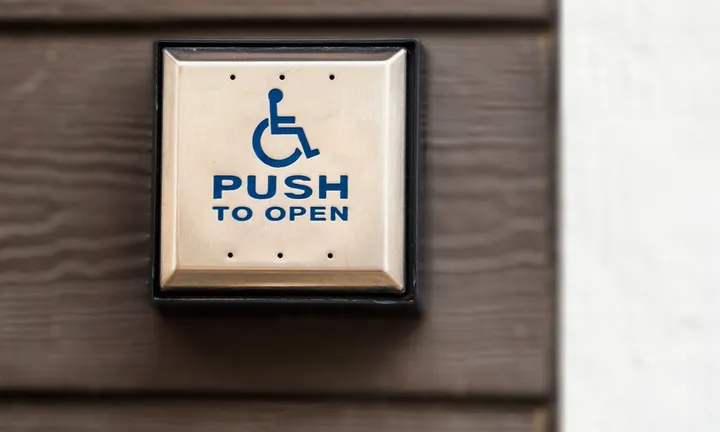
Threshold heights, door-opening force, clear door width, and the presence of automatic openers all fall under ADA scrutiny. Accessible parking, loading zones, public restrooms, sales counters, accessible tables, and aisle width are among the most common barriers cited in physical access lawsuits. Entryways are an everyday flashpoint. A door that requires more than 5 pounds of pressure to open fails the standard. A threshold higher than half an inch can be a violation. These are easy to overlook and easy to fix. You just need a contractor with an eye for detail.

Restrooms

This is where most older Fort Worth commercial buildings have the most work to do. Stall dimensions, grab bar placement and load rating, sink height, knee clearance, mirror height, and turning radius all have specific requirements under the 2010 Standards. 

A restroom that passed inspection in 1988 likely does not meet current standards. 

Counter and Service Heights

Checkout counters, reception desks, and restaurant bars must have at least a portion of the surface at an accessible height. The standard calls for a section no higher than 36 inches. Many older retail and hospitality spaces in DFW have full-height counters throughout with no accessible sections. This is a straightforward fix during a renovation.

Path of Travel

The interior route from the accessible entrance to the main areas of your building must be barrier-free. This includes ramp slopes, changes in floor surface, and minimum aisle widths. A building can have a compliant front entrance and still fail on the interior path of travel. 

Signage

ADA-compliant signage requires Braille, raised tactile characters, and specific mounting heights. Restroom signs, room identification signs, and directional signs all have requirements. This is one of the lower-cost compliance items and one of the most commonly overlooked.

Proactive vs. Reactive: The Real Cost Difference

The financial math here is straightforward. Planned accessibility work costs less than forced accessibility work. Every time.

A proactive retrofit can be scheduled during off-hours, phased across low-traffic periods, and designed with your business operations in mind. You control the timing, the scope, and the contractor. You can budget for it properly.

A demand letter or lawsuit changes all of that. Now you’re paying legal fees to respond to the complaint. You may be paying a settlement. And you still have to do the retrofit; except now it’s on a court-imposed timeline, and you may have less flexibility in how the work is sequenced. 

There are also tax incentives worth knowing about. The IRS offers a Disabled Access Credit for small businesses that make accessibility improvements, and a Section 190 deduction is available for barrier removal expenses. These incentives apply to planned work, not to emergency retrofits in response to litigation.

Texas adds a plan review component. For any renovation project that triggers TAS review, you will need to submit construction documents to TDLR before work begins. A contractor who understands the process can prepare those documents correctly the first time. Resubmissions cost time and money.

The bottom line is this: a proactive accessibility assessment costs far less than a reactive one. Identifying three violations and correcting them on your schedule is a manageable project. Correcting those same three violations under legal pressure, while also managing attorneys and court deadlines, is a much harder problem.

How Design-Build Minimizes Disruption to Your Business

Commercial accessibility work is different from residential work. You have tenants, customers, operating hours, and lease obligations to think about. Construction that shuts down your building for weeks is not an option for most property owners.

The design-build approach solves most of that problem. When one team handles the accessibility assessment, design, permitting, and construction, there is no handoff between firms. An architect who designs the work but doesn’t manage the crew creates gaps. A general contractor who didn’t help design the scope sometimes misses the intent. A single team with shared accountability builds and constructs more efficiently.

Phased scheduling is the standard approach for occupied commercial properties. Restroom work gets done over a weekend. Parking lot re-striping happens after hours. Entryway modifications are sequenced so that at least one accessible entrance remains open at all times. Multi-suite buildings require coordination with individual tenants, and a contractor with commercial experience handles that communication as part of the job.

The first step is an accessibility audit and site walk-through. This is a structured review of your property against the 2010 ADA Standards and TAS requirements. You come away with a written scope of work, a prioritized list of violations, and a realistic estimate. That document is also useful for insurance purposes and for demonstrating good-faith compliance efforts.

RockAway has been doing commercial remodeling in Fort Worth and the DFW area for over 31 years. Our commercial accessibility work covers office buildings, retail centers, restaurants, and medical practices across Tarrant County and the surrounding communities. We understand TAS plan review requirements and work on schedules that keep your business operational throughout the project.

Ready for a Site Walk-Through? Contact RockAway Today!

If your building was constructed before 1991, or if you’ve made changes since then without a formal accessibility review, a site walk-through is the right starting point. You’ll know exactly where you stand and what it will take to get compliant, before anyone else tells you.

Call The RockAway Company to schedule your free commercial accessibility assessment. We serve Fort Worth and the full DFW Metroplex, and are ready to help you get your building ADA-compliant. Contact us today!

Categorised in: